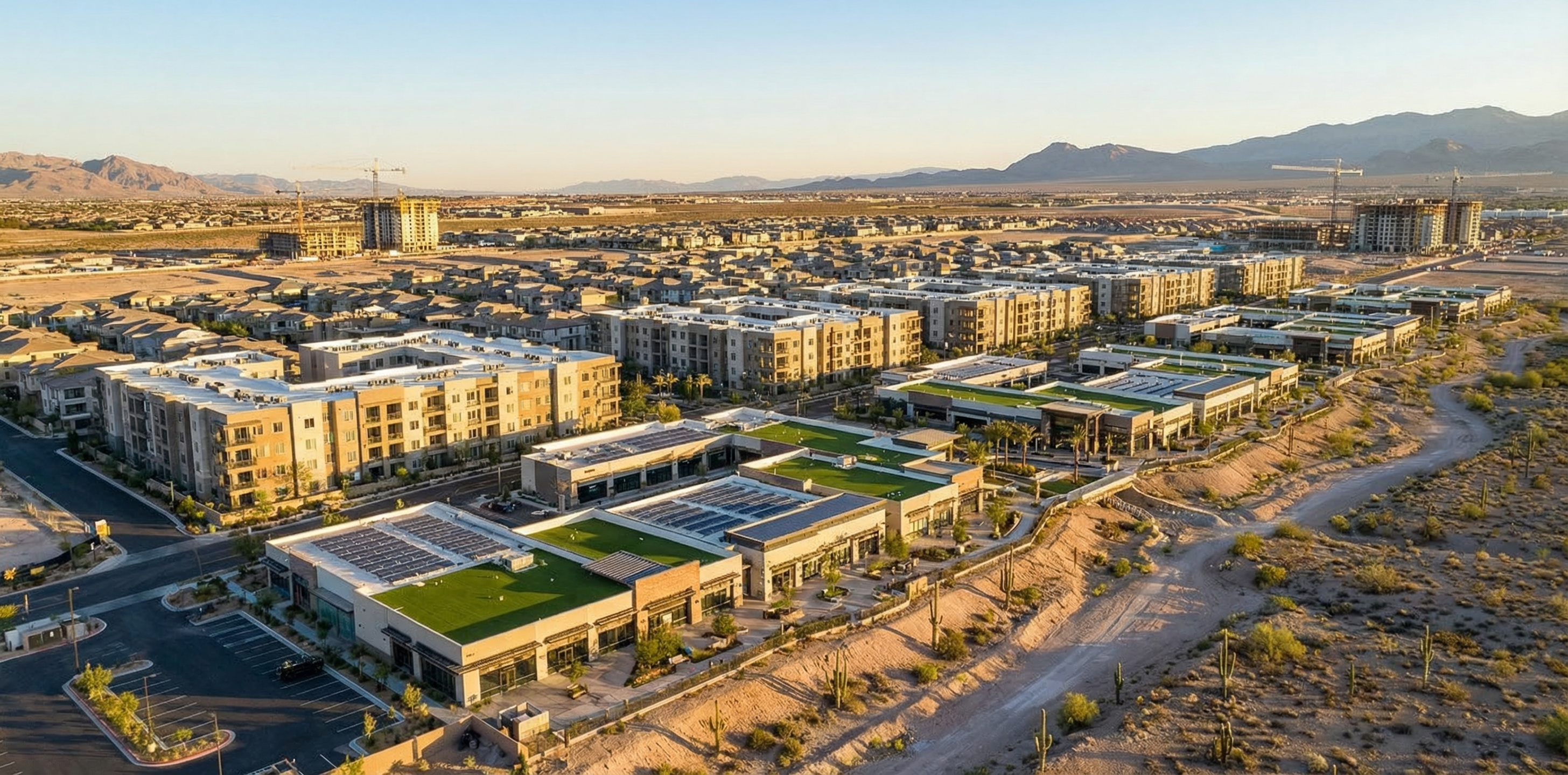
Las Vegas has always been about high stakes. But in 2026, the real money isn’t on the casino floor — it’s on the balance sheet. A new generation of young real estate investors is making calculated bets on Southern Nevada, and the market fundamentals are doing most of the convincing.
This isn’t the speculative frenzy of the mid-2000s. The investors moving into the Las Vegas market today are data-driven, long-horizon thinkers who see something that coastal markets stopped offering years ago: a combination of relatively accessible entry points, tax advantages, structural population growth, and supply constraints that don’t look like they’re easing anytime soon.
The Numbers Don’t Lie
The headline figures from Clark County’s 2026 data tell the story efficiently. The median listing price for Las Vegas homes now sits at $465,000, up 12.4% year-over-year. Average home values, per Zillow, are tracking at approximately $426,948 — a 9.8% annual gain. The condo and townhome segment, historically an entry point for younger buyers and investors, is at $305,000.
On the rental side, median monthly rent for a house has climbed to $2,195 — a 5.7% increase — while the vacancy rate hovers at approximately 2.8%. To put that in context: a healthy rental market is generally considered to sit around 5% vacancy. At 2.8%, Las Vegas is undersupplied, and the pressure isn’t letting up. Average days on market has dropped to around 30 — faster than most comparable metros.
For a 25-year-old investor running the math on cash flow, cap rates, and long-term appreciation, those numbers represent something that’s genuinely hard to find right now. Compare it to the coastal markets they grew up in: Los Angeles, San Francisco, Seattle. Entry prices in those cities require either inherited capital or years of accumulation that many young professionals simply don’t have. Las Vegas offers a different path.
And Nevada has no state income tax. That detail isn’t a footnote — for investors structuring income around rental revenue or capital gains from property flips, it’s a meaningful structural advantage that compounds over years.
Why the Young Money Is Moving Here
The market statistics matter, but they don’t fully explain the gravitational pull Las Vegas holds for young investors in 2026. The deeper story is about demographics and infrastructure.
Clark County’s population is approximately 2.40 million and growing at 1.7% annually. The median age is 38 — younger than many Sun Belt competitors, and reflective of the steady stream of transplants arriving from higher-cost markets. These aren’t retirees. They’re working adults, remote workers, and small business owners who need housing.
The inbound migration pattern is structural: California residents priced out of their home state, young professionals from the Pacific Northwest seeking more affordable professional environments, and a growing tech and logistics workforce drawn by the region’s expanding corporate footprint. Amazon, Google, and Switch all operate significant facilities in the valley. The University of Nevada Las Vegas recently opened its medical school — a long-term signal of a city building knowledge-economy infrastructure, not just casino expansion.
The biggest single wildcard for long-term property values is Brightline West’s high-speed rail project, a $12 billion initiative connecting Las Vegas to Los Angeles by 2028. If that project delivers on schedule, the calculus for Las Vegas real estate changes fundamentally: the city becomes a viable commuter market for a 40-million-person metro area. That’s not a speculative future — it’s a construction project already underway.
Building on Legacy: Clem Ziroli III
Among the young professionals who have made Las Vegas their professional home, Clem Ziroli III represents a particular archetype: the fourth-generation real estate professional who came to the market not as a newcomer, but as someone who grew up in the business.
Born in Southern California and educated at UNLV — where he earned a BA in Political Science after attending Bishop Gorman High School — Ziroli’s path into Nevada real estate was both deliberate and grounded in institutional knowledge. His family’s involvement in real estate spans generations, which means he entered the professional world with the kind of pattern recognition that usually takes a decade to develop on your own.
His primary professional platform is Diamond Creek Holdings (DCH), where he works as an asset manager overseeing a portfolio exceeding 600,000 square feet of commercial, industrial, and residential properties across the country. That’s not a startup position — it’s operational responsibility at scale, managing complex assets across multiple property types and geographies. The skillset required to manage that portfolio at a young age says something about both his preparation and his trajectory.
Alongside his work at DCH, Ziroli founded Battle Born Acquisitions, a Nevada-based investment firm focused on strategic real estate acquisitions and value-driven asset management. The name is a nod to Nevada’s state motto — “Battle Born” — and the firm’s orientation is toward long-term value creation rather than short-cycle flipping. He has also worked in sales and investment transactions through the Robledo Group, adding transactional experience to the asset management foundation.
Ziroli’s profile extends beyond real estate. He ran as a Republican candidate for Nevada State Assembly District 34 in 2024, advocating for housing affordability policies and first-time homebuyer programs — issues that sit at the intersection of his professional expertise and his sense of civic obligation. It’s the kind of combination — operating competence paired with policy engagement — that tends to distinguish the young entrepreneurs who build lasting professional reputations from those who focus narrowly on deal flow.
What’s notable about Ziroli’s positioning in the Las Vegas market isn’t the deal count or the square footage. It’s the approach: disciplined, systems-oriented, and built on fundamentals that don’t depend on a hot market to work. In a city with a history of boom-bust cycles, that’s a meaningfully different posture.
The Broader Generational Shift
Ziroli isn’t an outlier. He’s part of a generational current that’s reshaping how young Americans think about wealth building.
According to QuickBooks’ 2026 Entrepreneurship Trends report, 43% of Gen Z adults are considering starting a business this year — a higher rate than Millennials (39%) and more than double Gen X (21%). And a 2023 Square survey of Gen Z entrepreneurs found that 84% plan to remain business owners over the next five years, with 73% reporting that their business is now their primary income source.
What’s driving this isn’t just ambition — it’s risk recalibration. Gen Z watched the 2008 financial crisis reshape their parents’ financial security. They graduated into an economy warped by COVID, inflation, and a venture capital cycle that has grown increasingly selective. The result is a generation that’s skeptical of equity-dependent wealth strategies and more interested in asset ownership.
Real estate, particularly in supply-constrained markets like Las Vegas, checks the boxes that matter to this cohort. It’s tangible. It generates cash flow. It offers leverage that doesn’t require giving up equity. And in a market with Nevada’s tax structure, the after-tax math is genuinely compelling.
The 45% of Gen Z founders who bootstrapped their businesses using personal savings are the same cohort looking at a $305,000 Las Vegas townhome and doing the math on a 20% down payment versus what a similar position in a coastal market would require. The numbers in Nevada are within reach. The numbers in San Diego or Portland generally are not.
The Window Isn’t Open Forever
The argument for Las Vegas in 2026 is straightforward: supply is tight, demand is structural, the tax environment is favorable, and major infrastructure investments are creating long-term value drivers that aren’t yet fully priced in. For young investors who can access the market now — whether as direct buyers, through acquisition vehicles, or as asset managers on institutional portfolios — the positioning advantages are significant.
The caveat is timing. A 2.8% vacancy rate and 30-day average days on market signal that competition is already intense. The Brightline West announcement has been public for years, and forward-looking investors have been pricing that infrastructure premium into purchases since the project broke ground. As the 2028 rail connection approaches completion, the early-mover advantage narrows.
The generation of investors making their first serious real estate commitments right now — people like Clem Ziroli III, who entered the Las Vegas market with deep institutional grounding and are building platforms for long-term acquisitions — will likely look back on this window as the moment the calculus was clearest. The city has always attracted people who see opportunity in high-stakes environments. The difference in 2026 is that the opportunity is being driven by fundamentals, not just optimism.
That’s a different kind of bet. And increasingly, it’s the one young entrepreneurs are making.