

The short answer
A dog walking and pet sitting business looks after other people's animals while their owners are at work or away, through walks, drop-in visits or stays. Many people start with a few neighbors' pets and basics such as leashes, waste bags and a phone for updates. Permit rules for commercial dog walkers are set locally and vary widely, and insurance for animals in your care is a separate question to ask.
- Age guide From about 13, with a parent or guardian involved
- Startup cost Low: leashes, bags and a phone
- Time Short, regular visits around school and weekends
- Skill level Comfort with animals; reliability matters most
Free one-page starter sheet (PDF)
This article is general information for founders, not legal, tax, or financial advice. Rules, fees, and filing requirements vary by state and change over time. Nothing here creates a professional relationship of any kind. Confirm anything that affects your business with your state's filing office and a qualified attorney or accountant before you act on it.
Many young founders involve a parent or guardian from the start, since rules about contracts, bank accounts and online accounts often depend on age.
What is a dog walking and pet sitting business?
A dog walking and pet sitting business takes care of other people’s animals while their owners are at work, at school or away. Dog walking usually means a scheduled walk once or twice a day, and pet sitting covers drop-in visits for feeding, water and playtime or stays at the pet’s home. Startup costs are mostly a leash and a phone, which is why the idea appears so often on lists of low-cost businesses for young people. Unlike most ideas on this site, the thing being looked after is alive, which is why the safety and insurance questions below matter.
How do you start a dog walking business?
The order below is a typical flow, not a rule. Some founders price before they practice, and some skip steps until the first customer asks.
-
Start with animals you already know
Many young people begin with family pets and the dogs of neighbors they have already met. Knowing how a particular dog behaves on a leash, at a door and around other dogs is the main skill.
-
Decide what a visit includes
A walk, fresh water, feeding, a litter box, playtime and a photo update are common parts of a visit. Writing down what each visit covers, and what it does not, keeps expectations clear.
-
Meet the pet and the owner first
A short meet-and-greet and a written note on vaccinations, the owner's and vet's contact details, medical needs, feeding and behavior help. Many sitters also ask who may authorize vet care if something goes wrong.
-
Work out a starting price
Add up the small costs of a visit, how long a visit takes including travel, and what an hour of the founder's time should be worth. The result is a starting point that can change after the first few visits.
-
Check the paperwork with an adult
Rules for commercial dog walkers, parks, the number of animals at one address and insurance all vary by place. A parent or guardian, the city or county and an insurance agent can say what applies.
-
Find the first customers
Neighbors, family friends and community groups are where many young founders begin, and word of mouth is how many sitters grow. Pet-care apps and websites set their own age rules, so reading a platform's terms comes first.
What do you need to start a pet sitting business?
Most young founders begin with a short list and add items only once customers are asking for more.
Many people start with
- A sturdy leash, plus a spare
- Waste bags and water for the walk
- A phone for updates and photos
- A written note for each pet: contacts, vet, feeding and behavior
Often added later
- A pet first-aid kit
- A written service agreement, reviewed by a parent or guardian
- Insurance that covers animals in your care
- Business registration and simple branding
Is dog walking and pet sitting a good fit for you?
Often a good fit if you
- are comfortable around animals and calm when something unexpected happens
- can name a few neighbors with pets who might want regular help
- can be reliable on a set schedule, including weekends and holidays
Worth thinking twice if you
- are nervous around larger or unfamiliar dogs
- would find being responsible for someone else's pet stressful
- live where parks or the city limit commercial dog walking
What rules might apply to dog walking and pet sitting?
Whether dog walkers need a permit depends on where they work, and the rules are set locally, so they are uneven. A few examples show how much they differ.
- City and park permits. San Francisco’s animal care agency says people walking four or more dogs, up to a limit of eight, must carry an annually renewed commercial dog walking permit on city property, with proof of general liability insurance among the requirements. East Bay Regional Park District in California says commercial dog walkers need a permit however many dogs they walk, up to a limit of six. The National Park Service says commercial dog walkers in the Golden Gate National Recreation Area need a Commercial Use Authorization and may walk no more than six dogs at a time. The City of Boulder, Colorado, says commercial dog walkers need a Commercial Use Permit to bring dogs to its Open Space and Mountain Parks.
- Age and dog-count limits. Denver’s dog park rules say the person in charge of a dog must be 16 or older, that people aged 11 to 15 must be accompanied by an adult, that one person may not be in charge of more than two dogs at a time, and that commercial uses are not allowed in a dog park. Those are Denver Parks and Recreation’s published rules, so checking for updates matters.
- Animals kept at home. Counties can also cap how many animals a household keeps. Clark County, Nevada, for example, offers a dog or cat fancier and foster permit for keeping more than three but not more than six spayed or neutered dogs at one location, so people planning to look after clients’ dogs at their own home may want to ask about local pet-number limits.
- Registration and zoning. The SBA says local governments determine registration, licensing and permitting requirements, and that zoning rules can apply even to home-based businesses.
- Age. Rules about contracts, bank accounts and payment apps often depend on age, which is one reason many young founders involve a parent or guardian from the start. The Business Ideas guide covers that in more detail.
Questions to ask your city or county
People commonly put questions like these to the local business office. The list is not complete, and the answers vary by place.
- Does the city or county ask commercial dog walkers or pet sitters to register or hold a permit?
- Do parks, trails or dog parks set age limits, limits on how many dogs one person can walk, or bans on commercial use?
- Is there a limit on how many animals can be kept at one home, and a permit for more?
- Are leash, waste and licensing rules different for people who walk dogs for pay?
- Does the neighborhood or homeowners' association have its own rules?
Do pet sitters need insurance?
Requirements vary by place, and nothing in the sources reviewed for this guide makes insurance mandatory everywhere. What the industry describes is more specific than “get insured”. Pet Sitters International, a trade association, explains that a bond is not insurance: it is a guarantee to clients that they would be paid if an employee stole from them, while liability insurance addresses bodily injury or property damage caused to others. It also says most standard general liability policies exclude personal property in your care, which includes clients’ pets, which is why “care, custody or control” coverage is commonly discussed. The National Association of Professional Pet Sitters describes the same coverage as central to a pet sitter’s insurance and lists dog escapes, pet-to-pet injuries and dog bites among the kinds of claims sitters see (2013 article). Both associations have commercial relationships with insurers, so their guidance is best read as an industry perspective. Insurance regulators also warn that a homeowners or renters policy may not cover a home-based business, so an insurance agent is the usual person to ask.
How do pet sitters work out a price?
Pricing is arithmetic more than a guess. A common approach is to add the small costs of one visit to the time a visit takes, including travel, multiplied by the hourly pay the founder wants, then compare the result with what nearby sitters charge. Many founders adjust after their first handful of visits. Prices vary a great deal by place, so this guide gives no figures.
What can go wrong?
The honest answer is that the animal is the risk. Dogs bite, slip collars, bolt through doors and pull on leashes, and a sitter who is responsible for a pet is also responsible for noticing when something is wrong. Rules on who pays after a bite vary by state. Other common trouble is quieter: taking too many dogs at once, skipping the meet-and-greet, losing track of feeding or medication instructions, or having no plan for an emergency vet visit. Starting small, writing everything down, declining animals beyond your experience, and having a parent or guardian involved in agreements, payments and insurance questions matter more than any equipment.
Frequently asked questions
How do you start a dog walking business?
Many people start with a few neighbors' dogs they already know, decide what a walk includes, meet each pet and owner first, work out a price from visit length and costs, and check local rules with a parent or guardian. Permit, park and insurance rules vary by place, so many founders ask the city or county early.
Do you need a permit to be a dog walker?
It depends on the city, county and park. San Francisco, for example, requires an annually renewed permit for walking four or more dogs and caps walkers at eight, East Bay Regional Park District in California requires a permit for any commercial dog walker, and Denver bans commercial use in its dog parks. Many places differ, so the local animal control office and park agency have the answer.
How old do you have to be to be a dog walker?
No single age applies everywhere. Denver's dog park rules, for example, say the person in charge of a dog must be 16 or older and that people aged 11 to 15 must be accompanied by an adult, while pet-care apps set their own minimum ages. Many young founders start informally with neighbors and involve a parent or guardian from the start.
Do pet sitters need insurance?
Requirements vary by place. Pet Sitters International, a trade association, says a bond is not insurance and that most standard general liability policies exclude coverage for pets in your care, which is why care, custody or control coverage is discussed in the industry. San Francisco asks for proof of general liability insurance for its permit. An insurance agent can explain the options.
More business ideas to look at

Lawn care
Mow, edge and tidy yards for neighbors on a regular schedule.

Tutoring
Help other students learn a subject you already know well.

Reselling
Sell used or secondhand items online or locally for more than they cost.
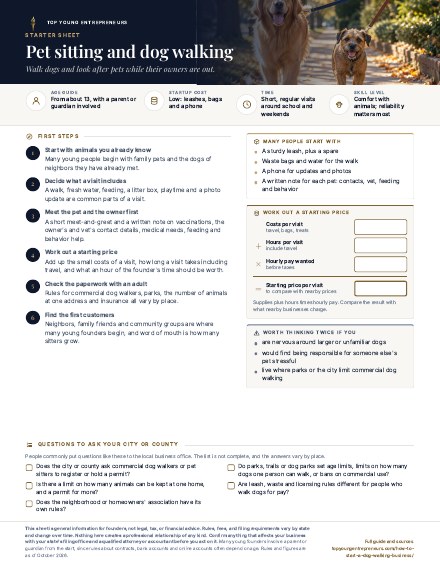
Free download
Pet sitting and dog walking: the one-page starter sheet
The first steps, a starter kit, a simple price worksheet and the questions worth asking locally, on one easy-to-print page.
Keep reading
- LLC vs. sole proprietorship How the two structures compare, described without telling you which to pick.
- The LLC formation checklist A map of the typical stages if a business grows into a company.
- How to get an EIN What the IRS's free business number is, who applies for one and the steps, from the IRS's own pages.
- How to start a business in Nevada The LLC steps, state fees, forms and local licenses in one state, with a printable checklist.
- The best states to start a business in 2026 A sourced comparison of state taxes and filing fees.
- Founders we have profiled Real people who built companies young, independently verified.
- How Top Young Entrepreneurs works Our editorial standards and how we source facts.
This article is general information for founders, not legal, tax, or financial advice. Rules, fees, and filing requirements vary by state and change over time. Nothing here creates a professional relationship of any kind. Confirm anything that affects your business with your state's filing office and a qualified attorney or accountant before you act on it.
Many young founders involve a parent or guardian from the start, since rules about contracts, bank accounts and online accounts often depend on age.
- San Francisco Animal Care & Control: Dog walker permit: permit threshold, dog limit and insurance proof for walkers on city property
- East Bay Regional Park District: Dog permits: a park district that requires a permit for commercial dog walkers
- National Park Service: Golden Gate National Recreation Area commercial dog walking: a federal park that requires a Commercial Use Authorization
- City of Boulder: Voice and sight program: a permit for commercial dog walkers in open space
- Denver Parks and Recreation: Dog park rules and regulations: age and dog-count limits and a ban on commercial use in dog parks (check for updates)
- Clark County, Nevada: Animal permits: an example of a county permit for keeping more than three dogs at one location
- Pet Sitters International: Pet sitting insurance guide: a trade association's explanation of bonds, liability and care, custody or control coverage
- National Association of Professional Pet Sitters: Pet sitter insurance 101 (2013): a trade association's overview of common claims
- SBA: Apply for licenses and permits: why many small and home-based businesses still register locally
Last verified: October 1, 2026. Rules, fees and age limits change, so confirm current details with the source before acting on them. This article is educational, not legal, tax or financial advice.