

The short answer
A tutoring business helps other students learn a subject you already know well, one on one or in small groups, in person or online. Many young people start with younger students from their school or neighborhood, with a parent or guardian aware of every session. Online tutoring marketplaces such as Wyzant, Outschool and Preply say tutors must be 18, while Schoolhouse.world accepts volunteer tutors from 13.
- Age guide From about 14 informally; most online marketplaces say 18
- Startup cost Low: your notes, a phone and a quiet place
- Time Flexible, around the school calendar and exam seasons
- Skill level Strong in a subject and patient explaining it
Free one-page starter sheet (PDF)
This article is general information for founders, not legal, tax, or financial advice. Rules, fees, and filing requirements vary by state and change over time. Nothing here creates a professional relationship of any kind. Confirm anything that affects your business with your state's filing office and a qualified attorney or accountant before you act on it.
Many young founders involve a parent or guardian from the start, since rules about contracts, bank accounts and online accounts often depend on age.
What is a tutoring business?
A tutoring business helps other students learn something they find hard, usually one on one and usually for a fee. A student a few grades younger who is stuck on fractions, a classmate preparing for an exam or a child who needs reading practice are typical examples. The only equipment is knowledge, patience and a way to meet, which is why tutoring appears on lists of low-cost businesses for young people. It also means working with other people’s children, which is why the safety and agreement questions below come first.
How do you start a tutoring business?
The order below is a typical flow, not a rule. Some founders volunteer before they charge, and some skip steps until the first family asks.
-
Pick one or two subjects you know well
Many tutors begin with a subject and grade level they recently mastered, such as middle school math or reading. Being able to explain an idea in more than one way matters as much as the grade.
-
Decide the format and the place
Sessions can happen at a library or another public place, at a student's home with an adult present, or online with a parent or guardian nearby. Safety guidance from Purdue's youth programs and from Wyzant favors public spaces and an adult being present.
-
Plan each session
Many tutors keep a short plan, a few practice problems and a note of what was covered, so the next session can pick up where the last one stopped.
-
Work out a starting price
Add up materials and travel, how long a session takes including preparation, and what an hour of the founder's time should be worth. The result is a starting point that can change after the first few sessions.
-
Check the rules and the paperwork with an adult
Platform age limits, local registration, agreements and tax questions often depend on age and location. A parent or guardian, the school or library and the city or county business office can say what applies.
-
Find the first students
Younger students at the same school, friends' siblings and neighbors, with their parents' agreement, are where many young tutors begin. Volunteering first is another route, for example through a free program such as Schoolhouse.world.
What do you need to start a tutoring business?
Most young founders begin with a short list and add materials only once students are asking for more.
Many people start with
- Notes, practice problems and paper or a whiteboard
- A public place, or a laptop and a video call set-up with a parent nearby
- A notebook for what each session covered
- A way to message parents that they can see
Often added later
- Printed practice sets for each subject
- Training or certification offered by a tutoring program
- A written agreement on schedule, cancellations and payment, reviewed by a parent or guardian
- Business registration and simple branding
Is tutoring a good fit for you?
Often a good fit if you
- explain things clearly and stay patient when someone is stuck
- are strong in a subject and a few grade levels ahead of the students
- can work around the school calendar, including exam seasons
Worth thinking twice if you
- are tempted to do a student's homework rather than teach
- would find it hard to keep a student's parents updated
- have no adult to help arrange a safe place or an online set-up
How old do you have to be to tutor?
There is no single answer, because informal tutoring, online marketplaces and volunteer programs set different rules. As of October 2026, their published pages say the following, and terms change, so each page has the current rule.
| Where | What its published page says |
|---|---|
| Wyzant | Tutors must be at least 18, live in the United States and have a valid Social Security Number; tutors are not required to be certified teachers. |
| Outschool | Educators must be at least 18. |
| Preply | Applicants must be at least 18. |
| Schoolhouse.world | A free volunteer program that does not allow anyone under 13 to become a tutor. It encourages students themselves to tutor, and tutors get certified through Khan Academy in the subject they want to tutor. |
Informal tutoring, such as helping a neighbor’s child once a week, is not covered by any of those pages, and many younger people start that way with a parent or guardian aware of every session. For employees aged 14 and 15, federal child labor rules list “teaching or performing as a tutor” and computer programming among the types of work that are permitted, subject to the rule’s hours and conditions. That rule concerns employment rather than running your own tutoring business, and state rules can be stricter.
How do tutors keep sessions safe?
Tutoring programs describe a few habits that reduce one-on-one risk, and none of them are legal requirements for an informal tutor. Purdue University’s youth-protection guidance for its programs lists, as examples of rules that avoid private interactions, copying a child’s parent or the program director on electronic communication, including communication involving staff under 18, and holding tutoring or mentoring sessions in public spaces where other participants or staff can see them. Wyzant’s tutor safety tips suggest holding lessons in public places such as coffee shops and libraries and having an adult present when the student is under 18. Many young tutors follow similar habits, tell a trusted adult where and when a session will happen, and keep short notes on what each session covered.
How do tutors work out a price?
Pricing is arithmetic more than a guess. A common approach is to add the materials and travel cost of one session to the time a session takes, including preparation, multiplied by the hourly pay the founder wants, then compare the result with what nearby tutors charge. Many founders adjust after their first handful of sessions. This guide gives no figures because they vary widely by subject, level and place.
What rules might apply to a tutoring business?
The details depend on the state, the city and the kind of tutoring, which is why a quick call to the local business office and a conversation with a parent or guardian are a common first step.
- The kind of tutoring. Rules can attach to particular kinds of tutoring. Pennsylvania’s Department of Education, for example, says private tutoring is one way to satisfy compulsory school attendance and that a private tutor in that arrangement must be certified by the Commonwealth to teach in the state’s public schools. That example concerns tutoring used in place of school attendance, not homework help or test preparation, and other states differ.
- Registration and zoning. The SBA says local governments determine registration, licensing and permitting requirements, and that zoning rules can apply even to home-based businesses.
- Platforms. Marketplaces set their own age limits, as above, and volunteer programs set their own training requirements.
- Age and money. Rules about contracts, bank accounts and payment apps often depend on age, which is one reason many young founders involve a parent or guardian from the start. The Business Ideas guide covers that in more detail.
Questions to ask before the first session
People commonly put questions like these to a parent or guardian, a school or library, and the local business office. The list is not complete, and the answers vary by place.
- Does the city or county ask a tutoring business, including a home-based one, to register or hold a license?
- Does the school, library or community center that might host sessions have rules for outside tutors?
- Do an online platform's terms allow someone of this age to tutor, or is volunteering the option?
- Do the student's parents or guardians agree to the place, the time and how messages are shared?
- Does any state rule apply to the kind of tutoring offered, such as tutoring used in place of school attendance?
What can go wrong?
The honest answer is that tutoring is a trust business. Doing a student’s homework instead of teaching, promising grade or test-score results, meeting alone in a private place, sharing a student’s name, photo or work without a parent’s permission, or having no written agreement about schedule, cancellations and payment are the usual sources of trouble. Teaching material you have not yet mastered is another. Public places, a parent or guardian who can see the messages, a short note after each session and an adult who understands the paperwork matter more than any materials.
Frequently asked questions
How do you start a tutoring business?
Many people start by choosing one or two subjects they know well, offering sessions to younger students they or their parents already know, meeting in public places or online with a parent or guardian nearby, and working out a price from time and materials. Platform age rules, local registration and contract rules vary, so many founders check them with a parent or guardian.
How old do you have to be to be a tutor?
No single age applies everywhere. As of October 2026 Wyzant, Outschool and Preply say tutors must be 18, while Schoolhouse.world, a free volunteer program, says it does not allow anyone under 13 to become a tutor. Many younger people tutor informally with a parent or guardian aware of every session, and an adult can help with agreements and payments.
Do you need a license to be a tutor?
It varies. Wyzant says its tutors are not required to be certified teachers, but rules can attach to particular kinds of tutoring: Pennsylvania's Department of Education says a private tutor used to satisfy compulsory school attendance must be certified to teach in public schools there. Local business registration can also apply, so many founders ask the city or county and the state education agency.
How do tutors keep sessions safe?
Safety guidance from Purdue University's youth programs and from Wyzant suggests holding sessions in public spaces or online with a parent or guardian involved, copying parents on messages, and having an adult present when the student is under 18. Many young tutors follow similar habits and keep short notes on what each session covered.
More business ideas to look at

Pet sitting and dog walking
Walk dogs and look after pets while their owners are out.

AI automation and vibe coding
Learn to build small automations and tools for local businesses.

Social media help for local shops
Help a local shop plan, post and reply on social media.
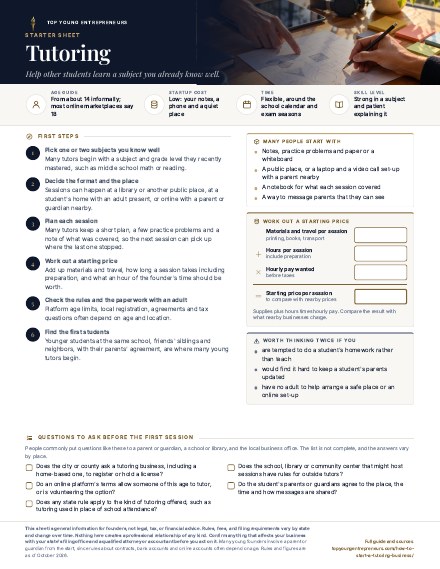
Free download
Tutoring: the one-page starter sheet
The first steps, a starter kit, a simple price worksheet and the questions worth asking locally, on one easy-to-print page.
Keep reading
- LLC vs. sole proprietorship How the two structures compare, described without telling you which to pick.
- The LLC formation checklist A map of the typical stages if a business grows into a company.
- How to get an EIN What the IRS's free business number is, who applies for one and the steps, from the IRS's own pages.
- How to start a business in Nevada The LLC steps, state fees, forms and local licenses in one state, with a printable checklist.
- The best states to start a business in 2026 A sourced comparison of state taxes and filing fees.
- Founders we have profiled Real people who built companies young, independently verified.
- How Top Young Entrepreneurs works Our editorial standards and how we source facts.
This article is general information for founders, not legal, tax, or financial advice. Rules, fees, and filing requirements vary by state and change over time. Nothing here creates a professional relationship of any kind. Confirm anything that affects your business with your state's filing office and a qualified attorney or accountant before you act on it.
Many young founders involve a parent or guardian from the start, since rules about contracts, bank accounts and online accounts often depend on age.
- Wyzant: Become a tutor: tutor requirements, including age and certification
- Outschool: Becoming an educator: minimum age for educators
- Preply Help: Register to teach on Preply: minimum age for tutors
- Schoolhouse.world: Can I become a tutor?: minimum age and certification for volunteer tutors (October 2024)
- Pennsylvania Department of Education: Home education and private tutoring guide (May 2026): an example of a rule that attaches to one kind of tutoring
- Purdue University Youth Protection: Guidance for youth programs: examples of rules a university program uses to avoid private one-on-one interactions
- Wyzant: Tutoring safety tips: a marketplace's safety suggestions for tutors
- 29 CFR 570.34: Work 14 and 15 year olds may do: federal child labor rule that lists tutoring as a permitted type of work for employees
- SBA: Apply for licenses and permits: why many small and home-based businesses still register locally
Last verified: October 1, 2026. Rules, fees and age limits change, so confirm current details with the source before acting on them. This article is educational, not legal, tax or financial advice.