

The short answer
A reselling business buys items, such as used clothes, shoes, books or electronics, and sells them again online or locally, aiming for more than the items cost. Many young people start by selling things they already own. Marketplaces set their own age rules, from 13 with a parent's permission to 18, and the IRS says income from selling goods is reportable whether or not a payment app sends a Form 1099-K.
- Age guide From about 13, through a parent's or guardian's account; some marketplaces say 18
- Startup cost Low: start with items you already own
- Time Flexible; sourcing, photos, listing and shipping all take time
- Skill level Attention to detail and honest descriptions
Free one-page starter sheet (PDF)
This article is general information for founders, not legal, tax, or financial advice. Rules, fees, and filing requirements vary by state and change over time. Nothing here creates a professional relationship of any kind. Confirm anything that affects your business with your state's filing office and a qualified attorney or accountant before you act on it.
Many young founders involve a parent or guardian from the start, since rules about contracts, bank accounts and online accounts often depend on age.
What is a reselling business?
A reselling business moves items from where they are cheap or unused to where someone wants them. That can mean clearing out a closet and selling the contents, buying clothes or sneakers at thrift stores and listing them online, or fixing and selling used electronics. The money comes from the gap between what an item cost and what a buyer pays, minus fees, shipping and time. Because the first stock can be things a person already owns, reselling appears often on lists of low-cost businesses for young people, and it is also one of the ideas where marketplace rules, taxes and scams come up soonest.
How do you start a reselling business?
The order below is a typical flow, not a rule. Some founders pick a marketplace before they pick items, and some skip steps until the first sale.
-
Start with things you already own
Many resellers begin by clearing out their own closet, shelves and garage. It teaches photos, descriptions, shipping and how buyers behave without spending money on stock.
-
Check what similar items actually sold for
On many marketplaces, sold or completed listings show what buyers really paid, which can differ from what sellers ask. Fees, shipping and returns come out of every sale.
-
Pick one marketplace and read its rules
Age rules and account rules differ from site to site. Some require a parent or guardian to own the account, and some say 18, so many young sellers start where the rules are met.
-
Photograph and describe items honestly
Clear photos, visible flaws, measurements and an accurate description lead to fewer disputes and bad ratings.
-
Work out the lowest listing price
Add what was paid, the fees and shipping, and the profit the founder wants. The result is the lowest price that still leaves that profit, and it can change as items sell or sit.
-
Keep records and check the paperwork with an adult
A simple record of what was paid and what was sold makes any later filing easier. Taxes, payout accounts and platform accounts often depend on age, so a parent or guardian can help.
What do you need to start a reselling business?
Most young founders begin with a short list and add stock and equipment only once items are selling.
Many people start with
- Items you already own and are ready to sell
- A phone for photos and a plain background
- Packing supplies: boxes, tape and labels
- A spreadsheet for what you paid and what you sold
Often added later
- A small stock of items bought to resell
- A shipping scale and a label printer
- A second marketplace or a local pickup routine
- Business registration and simple branding
Is reselling a good fit for you?
Often a good fit if you
- like hunting for good finds and checking the details
- can photograph and describe items carefully
- are comfortable packing and posting orders on time
Worth thinking twice if you
- would find disputes, returns and unhappy buyers stressful
- have no adult to help with a marketplace account or payouts
- expect every item to sell quickly or at a set price
How old do you have to be to resell online?
Each marketplace sets its own rules for who may hold an account. The list below is as of October 2026, and terms change, so each marketplace’s own page has the current rule.
| Marketplace | What its published page says |
|---|---|
| eBay | Its user agreement (effective June 28, 2026) lists using the services when you are not able to form legally binding contracts, for example if you are under 18, among the things users agree not to do. |
| Mercari | Account holders must be at least 18, or the age of majority in their state. Minors under 13 are not permitted, and people aged 13 to 17 may use Mercari only if the account is owned by and registered in the name of a parent or legal guardian. |
| Poshmark | People under 13 may not use the service, and people aged 13 to 17 may use it only with a parent or guardian’s permission. |
Other marketplaces, including Etsy, Depop and Facebook Marketplace, set their own rules that this guide did not confirm, so their terms pages are the place to look. Because several of these rules involve a parent or guardian, many young resellers start with a family member’s account and agreement, and an adult can also help with payout accounts and agreements, which often depend on age.
How do resellers work out a price?
Pricing is arithmetic more than a guess. A common approach is to add what was paid for an item, the marketplace fees and shipping, and the profit the founder wants, which gives the lowest listing price that still leaves that profit, then compare it with what similar items actually sold for. Many resellers adjust as items sell quickly or sit unsold. Prices vary a great deal by item and platform, so this guide gives no figures.
Do resellers have to pay taxes on what they sell?
Tax rules depend on the facts, and the IRS is the place to confirm them. What the IRS says, as of October 2026:
- Reporting income. The IRS says income has to be reported on a tax return whether or not a Form 1099-K arrives, and that this includes payments for goods sold (including personal items such as clothing or furniture sold at a gain) or services provided.
- The 1099-K threshold. The IRS describes a payment app or online marketplace as required to send a Form 1099-K when payments for goods or services total over $20,000 in more than 200 transactions, though it may send one with lower amounts. The IRS says legislation retroactively reinstated the threshold that applied before the American Rescue Plan Act of 2021.
- Personal items. A loss on the sale of a personal item can’t be deducted, and a profit or gain on the sale of a personal item is taxable.
- Self-employment tax. The IRS says people generally owe self-employment tax if they have net earnings from self-employment of $400 or more, and that the rules apply no matter how old you are.
Many resellers keep records from the first sale, since the IRS says income is reportable whether or not a form arrives. A parent or guardian or an accountant can say how any of this applies in a particular case.
What scams and problem items come up in reselling?
- Fake payments. The FTC describes scammers posing as buyers who send a fake payment notification and hope the seller ships the item before noticing. It also describes overpayment scams, where a check is sent for more than the price and a refund of the difference is requested, and notes that it can take weeks for a bank to find that the check was fake. Its advice for online sellers includes not accepting a mobile payment from someone you don’t know, never depositing a check for more than the selling price, and not sharing a verification code with someone you don’t know.
- Counterfeits. eBay’s policy says you may list an item only if you are certain it is genuine. Federal law lists intentionally trafficking in goods while knowingly using a counterfeit mark as an offense.
- Recalled products. Federal law makes it unlawful to sell a consumer product that is subject to a voluntary corrective action taken by the manufacturer, in consultation with the Consumer Product Safety Commission, of which the Commission has notified the public. Used children’s gear, helmets and electronics are examples of items where a recall can matter.
- Meeting buyers. Local pickups mean meeting strangers. Many sellers choose a busy public place in daylight, bring someone with them or use a marketplace that ships.
What rules might apply to a reselling business?
The details depend on the marketplace, the state and the items, and a quick conversation with a parent or guardian and the local business office is a common first step.
- Marketplace rules. Age limits, restricted items and payout rules differ by marketplace, as above.
- Registration and sales tax. The SBA says local governments determine registration, licensing and permitting requirements, and that zoning rules can apply even to home-based businesses. Sales tax rules vary by state and can differ for goods and services, so the state tax agency is the place to ask.
- Age. Rules about contracts, bank accounts and payment apps often depend on age, which is one reason many young founders involve a parent or guardian from the start. The Business Ideas guide covers that in more detail.
Questions to ask before the first sale
People commonly put questions like these to a parent or guardian, the marketplace and the local business office. The list is not complete, and the answers vary by place and by platform.
- Do the marketplace's terms allow someone of this age to sell, or does a parent or guardian need to own the account?
- Does the city or county ask a reselling business, including a home-based or online one, to register or hold a license?
- Does the state charge sales tax on these sales, and who collects it?
- Which items does the marketplace restrict, such as brand-name goods that must be genuine?
- Has an item been recalled, and where can that be checked?
What can go wrong?
The honest answer is that items do not always sell. Stock that sits unsold ties up money, fees and shipping can leave less than expected, returns and disputes are part of the work, and a convincing scam can cost an item and the money for it. Buying brand-name goods that cannot be confirmed as genuine, selling recalled products without checking, accepting payment outside the marketplace, and shipping before money is actually confirmed in the seller’s own account are the usual causes. Starting with items already owned, honest photos and descriptions, records from the first sale, and a parent or guardian involved in accounts and payouts matter more than a big first purchase.
Frequently asked questions
How do you start a reselling business?
Many people start by selling things they already own, checking what similar items actually sold for, choosing one marketplace whose age rules they meet, photographing items honestly, working out the lowest price that covers costs and fees, and keeping simple records. Marketplace rules, taxes and contracts for minors vary, so many founders involve a parent or guardian.
Is reselling legal?
Reselling goods you bought is a common activity, but specific laws apply to some items. Federal law lists trafficking in goods that carry a counterfeit mark as an offense, and makes it unlawful to sell a consumer product that is subject to a manufacturer corrective action the Consumer Product Safety Commission has publicly announced. Marketplaces add their own rules, and the IRS says income from sales is reportable.
How old do you have to be to resell online?
It depends on the marketplace. As of October 2026 eBay's user agreement lists using its services when you cannot form legally binding contracts, for example if you are under 18, among the things users agree not to do. Mercari says 18, with 13 to 17 allowed only through an account owned by a parent or guardian, and Poshmark says 13 to 17 only with a parent or guardian's permission.
Do you have to pay taxes on reselling?
The IRS says income from goods you sell is reportable on a tax return whether or not a payment app or marketplace sends a Form 1099-K, that a profit on a personal item is taxable and that a loss on one can't be deducted. The IRS describes the 1099-K reporting threshold as over $20,000 in more than 200 transactions as of 2026. Confirm current rules with the IRS or a qualified accountant.
More business ideas to look at

Pet sitting and dog walking
Walk dogs and look after pets while their owners are out.

Social media help for local shops
Help a local shop plan, post and reply on social media.

Tutoring
Help other students learn a subject you already know well.
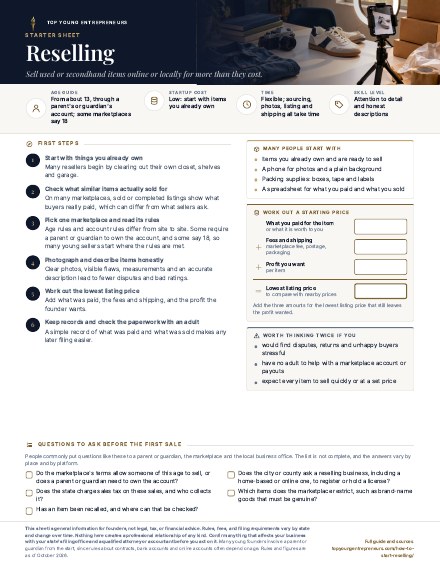
Free download
Reselling: the one-page starter sheet
The first steps, a starter kit, a simple price worksheet and the questions worth asking locally, on one easy-to-print page.
Keep reading
- LLC vs. sole proprietorship How the two structures compare, described without telling you which to pick.
- The LLC formation checklist A map of the typical stages if a business grows into a company.
- How to get an EIN What the IRS's free business number is, who applies for one and the steps, from the IRS's own pages.
- How to start a business in Nevada The LLC steps, state fees, forms and local licenses in one state, with a printable checklist.
- The best states to start a business in 2026 A sourced comparison of state taxes and filing fees.
- Founders we have profiled Real people who built companies young, independently verified.
- How Top Young Entrepreneurs works Our editorial standards and how we source facts.
This article is general information for founders, not legal, tax, or financial advice. Rules, fees, and filing requirements vary by state and change over time. Nothing here creates a professional relationship of any kind. Confirm anything that affects your business with your state's filing office and a qualified attorney or accountant before you act on it.
Many young founders involve a parent or guardian from the start, since rules about contracts, bank accounts and online accounts often depend on age.
- eBay User Agreement: effective June 28, 2026; who may use the services
- Mercari Help Center: Minors: age rules, including accounts owned by a parent or guardian
- Poshmark Terms of Service: age rules and parent or guardian permission
- IRS: Understanding your Form 1099-K: the reporting threshold and reporting income whether or not a form arrives (updated June 2026)
- IRS: Form 1099-K FAQs: the reinstated threshold (reviewed September 2026)
- IRS: What to do with Form 1099-K: personal items sold at a gain or a loss (updated July 2026)
- IRS Topic 554: Self-employment tax: the net earnings threshold and age
- FTC: Selling stuff online? Here's how to avoid a scam: fake payment notices, overpayments and verification-code requests
- FTC: How to spot, avoid and report fake check scams: why a check for more than the price is a warning sign
- eBay: Counterfeit item policy: listing only items you are certain are genuine
- 18 U.S.C. 2320: Trafficking in counterfeit goods or services: the federal offense
- 15 U.S.C. 2068: Prohibited acts (Consumer Product Safety Act): selling products subject to a public corrective action
Last verified: October 1, 2026. Rules, fees and age limits change, so confirm current details with the source before acting on them. This article is educational, not legal, tax or financial advice.