
The short answer
A mobile mechanic business travels to the customer to do maintenance and repairs, such as oil changes, batteries or brakes, using tools carried in a vehicle. Many people learn the trade first and then start with simple maintenance. Rules vary by state: Nevada has garage operators register with the DMV, and federal rules cover air-conditioning work and used oil. Insurance and driving rules matter here too.
- Age guide From about 18, mainly because of driving, registration and insurance
- Startup cost Higher: tools, a work vehicle and insurance
- Time Flexible hours, though jobs can run longer than planned
- Skill level Training and practice first; safe working habits matter most
Free one-page starter sheet (PDF)
This article is general information for founders, not legal, tax, or financial advice. Rules, fees, and filing requirements vary by state and change over time. Nothing here creates a professional relationship of any kind. Confirm anything that affects your business with your state's filing office and a qualified attorney or accountant before you act on it.
Many young founders involve a parent or guardian from the start, since rules about contracts, bank accounts and online accounts often depend on age.
What is a mobile mechanic business?
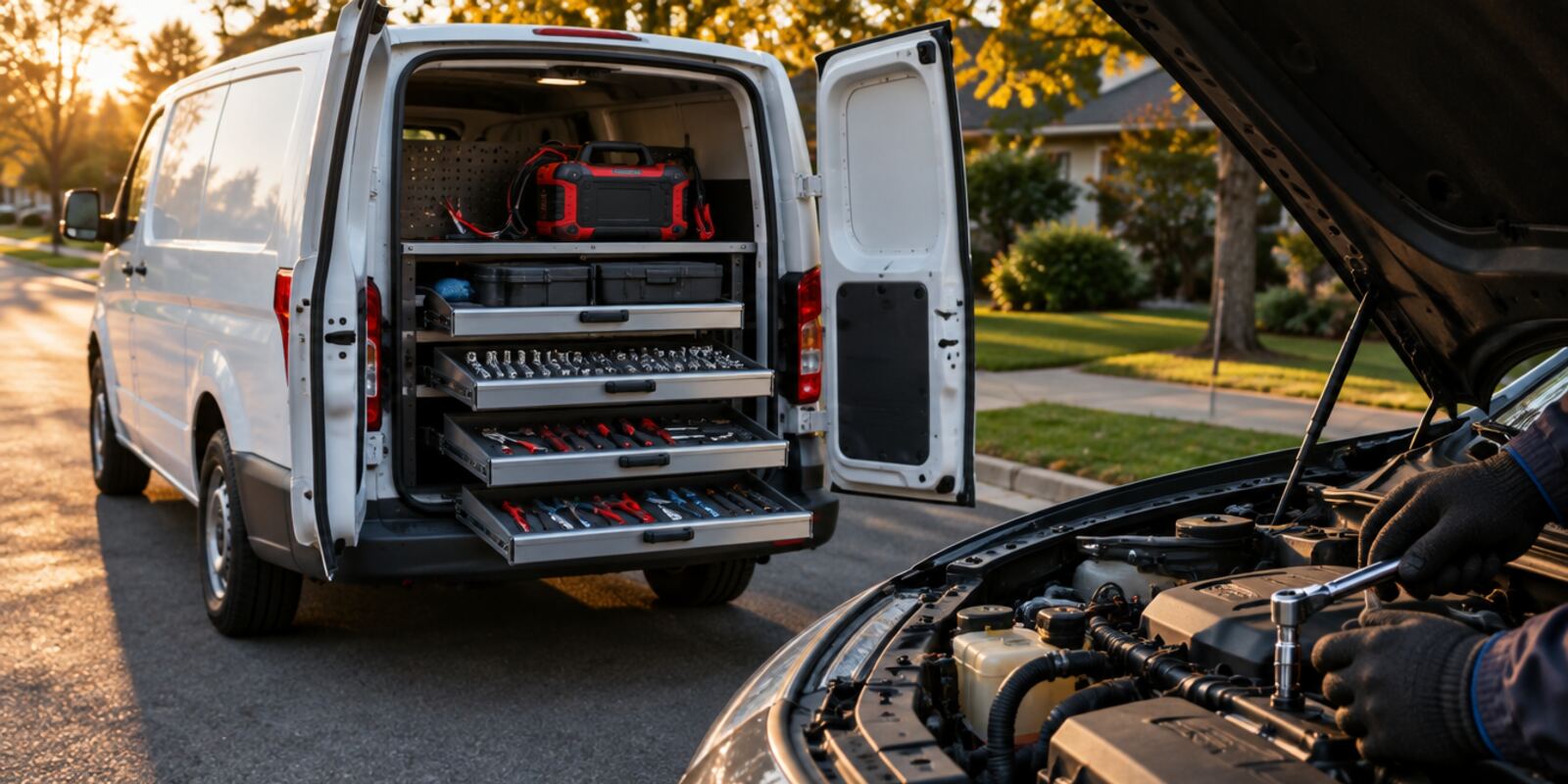
A mobile mechanic business brings the repair shop to the customer. The mechanic drives to a driveway, a workplace or a parking lot with tools and parts and does maintenance or repairs there, such as oil changes, batteries, brakes or working out why a car will not start. There is no shop to rent, but the work vehicle, the tools, the training and the insurance add up, which is why this idea sits at the higher end of the startup range in this section. It is also the idea where skills, safety and registration matter most, so this guide is more cautious than the others. Cleaning cars rather than repairing them has its own guides, for mobile car washing and mobile car detailing.
How do you start a mobile mechanic business?
The order below is a typical flow, not a rule. With this idea the skills come first, and the paperwork is heavier than for most of the others.
-
Build the skills first
Many people learn the trade before charging for it, through a school automotive program, a shop job or time alongside an experienced mechanic. Practice on family cars comes after the basics are solid.
-
Start with simple maintenance
Work on brakes, steering, airbags and fuel or electric systems usually calls for training and proper procedures, so many beginners stay with jobs such as oil changes, batteries and filters until they have both.
-
Check the registration rules
States differ. Nevada has garage operators register with the DMV, while other states register shops, name mobile operators or certify individual mechanics. The state agency and the city or county business office can say what applies to a mobile service.
-
Work out a starting price and put it in writing
Add up parts, supplies and tool wear, how long a job takes including travel, and what an hour of the founder's time should be worth. Written estimates are a common habit, and Nevada's garage statute requires one above a set amount.
-
Plan for oil, fluids and parts
Used oil, filters, coolant and batteries need a plan before the first job, because environmental rules apply to many businesses that handle them and a driveway is not a disposal site.
-
Find the first customers
Family, neighbors and friends with simple maintenance needs are where many founders begin. A short written list of the services offered, and the ones that are not, helps set expectations.
What do you need to start a mobile mechanic business?
Most mobile mechanics begin with a modest tool set and a plan for fluids, and add equipment as the jobs they take on call for it. Prices and specifications vary a great deal, so this guide gives no figures.
Many people start with
- A basic set of hand tools and a way to carry them
- Wheel chocks, jack stands, and eye and hand protection
- Drip pans, absorbents and containers for used oil and fluids
- A basic diagnostic tool, such as a code reader
Often added later
- A work vehicle, such as a van, set up with storage for tools and parts
- Training and approved refrigerant equipment, if air-conditioning work is added
- Business insurance and, where the state asks for it, a registration and bond
- Written estimate and invoice forms, and a way to keep records
Is a mobile mechanic business a good fit for you?
Often a good fit if you
- enjoy working with tools and working out why something is not working
- are willing to keep learning, including classes and certifications
- have reliable transport for tools and parts
Worth thinking twice if you
- are below the driving age or have no reliable way to reach customers
- are not ready to learn safety procedures for working on and around vehicles
- have no one who can help with registration, bond and insurance paperwork
How do you become a mobile mechanic?
There is no single path. ONET, the U.S. Department of Labor’s occupation database, places automotive service technicians and mechanics in “Job Zone Three: Medium Preparation Needed” and says most occupations in that zone require training in vocational schools, related on-the-job experience or an associate’s degree. Its description of the work includes diagnosing, adjusting, repairing or overhauling vehicles, routine maintenance such as oil changes, lubrications and tune-ups, and talking with customers about the work to be done. ONET describes jobs for employees, not owner-operators.
Some credentials are legal requirements and some are not. Under section 609 of the Clean Air Act, EPA says anyone who repairs or services a car’s air-conditioning system for payment or bartering must be properly trained and certified through an EPA-approved program, and EPA’s list of approved programs includes ASE and other providers. States add their own rules. Michigan certifies individual mechanics as well as registering repair facilities, while California, Florida and Nevada register repair businesses. Many people also spend time in a shop or alongside an experienced mechanic before taking customers of their own, which is where a founder can find out whether the work suits them.
Do mobile mechanics need a license in Nevada?
Nevada’s garage law says a garage operator registers with the state Department of Motor Vehicles, and it defines a garage by the work done, including repairs, tune-ups, diagnostics, alignments and oil changes on vehicles for the public. The statute reviewed describes no separate license for individual mechanics, and the documents reviewed do not say how the registration applies to a mobile service, so the DMV can confirm. Rules differ by state.
Nevada’s definition covers a business establishment, sole proprietorship, firm, corporation, association or other legal entity that performs services such as repair or replacement of the engine, brake, transmission, drivetrain, heating and air-conditioning, cooling, exhaust, electrical, charging or fuel systems, engine tune-ups, diagnostic testing, alignment, or oil changes and lubrication on motor vehicles for members of the public. The list includes oil changes, so even simple maintenance appears on it. The definition names sole proprietorships and does not mention a fixed location, vans or home-based work. The statute covers passenger cars, motorcycles, motor homes, recreational vehicles and trucks of 10,000 pounds or less, and says its rules do not apply to a business that is exclusively selling fuel, lubricants or goods unrelated to repairs.
As of October 2026, the DMV’s checklist for registering a garage (form OBL 274) lists the following items.
| Item | What the checklist says |
|---|---|
| Bond | A surety bond or a deposit in lieu of a bond, in the amount of $5,000 |
| Application fee | $25, non-refundable |
| Business license | A city or county business license |
| Place of business | “An established place of business within the state” |
| Customer sign | A “Garage Consumer Bill of Rights” sign, 22 inches by 28 inches, posted where customers can see it |
| Other items | Application forms signed by a principal of the business, a personal history questionnaire for each principal, a fictitious firm name filing, the business’s federal identification number and an email address |
The “established place of business” line is the open question for a mobile service. The statute itself asks for the street address of each location the applicant will be conducting business from and does not use the phrase for garages, and the documents reviewed here do not say how the DMV applies the checklist item to someone who works from a van or at a customer’s address, so the DMV’s Occupational and Business Licensing office is the place to ask.
A registration is valid for one year, the statute lets the DMV impose an administrative fine of up to $2,500 for a violation of the garage chapter, and the DMV offers an online tool for checking whether a garage is registered. The statute and the checklist state no minimum age, and the documents reviewed do not say how the DMV treats an applicant under 18.
Other states handle this differently. California registers automotive repair dealers and has requirements specific to mobile ones in rules that took effect in October 2025, such as a physical address where records are kept. Florida’s registration law names mobile motor vehicle repair shops. Michigan registers repair facilities and also certifies individual mechanics. A state’s own repair agency, not another state’s rules, is the place to confirm what applies.
What do mobile mechanics do with used oil and other fluids?
A job that drains oil, coolant or brake fluid leaves waste at the customer’s address, so a plan for it comes before the first job. EPA lists car repair shops, service stations and quick lube shops as common generators of used oil, and says individuals who change oil on their own personal vehicles are not subject to the used oil management standards. That exemption describes personal vehicles, not paid work. The federal rules for generators include keeping used oil containers in good condition, not leaking and clearly labeled “Used Oil.” Ohio EPA, explaining the rules to mobile oil-change businesses, says that once a business changes oil at a customer’s business it becomes a used oil generator. Nevada’s rules say a person who generates, transports or otherwise manages used oil must comply with the applicable federal standards (40 CFR Part 279, as they existed on July 1, 2018).
Storm drains matter here too. Northern Nevada’s Truckee Meadows handbook (published in 2007) has an entry on mobile fueling and lubrication, written mainly for tank-truck services, that says to keep drip pans under the vehicle whenever disconnecting hoses, liquid filters or draining fluids and to keep spill cleanup materials on the truck, such as absorbents and storm drain plugs or covers. Las Vegas Valley stormwater guidance says to change fluids carefully and use a drip pan. Rules for solvents, brake cleaner, antifreeze, batteries and tires are separate and are not covered in this guide, so the state environmental agency and the local waste authority can say how to handle them.
How do mobile mechanics work out a price?
Pricing is arithmetic more than a guess. A common approach is to add the cost of parts, supplies and tool wear for one job to the time the job takes, including travel, diagnosis and cleanup, multiplied by the hourly pay the founder wants, then compare the result with what nearby shops and mobile mechanics charge. Many founders adjust after their first handful of jobs, once they know how long jobs really take. Prices vary a great deal by place and by job, so this guide gives no figures.
What rules might apply to a mobile mechanic business?
The details depend on the state, city and county, which is why a call to the state agency and the local business office is a common first step.
- Registration. Covered above. States differ on who registers, whether mobile operators are named and which simple jobs are excluded, so the state’s own agency can say what applies.
- Estimates and customer paperwork. For garages, Nevada’s statute says a person requesting or authorizing a repair of more than $50 must be furnished a written estimate, and that if added charges exceed the estimate by 20 percent or $100, whichever is less, the garage operator notifies the owner. The person authorizing the repairs can waive these in writing (as of October 2026).
- Air conditioning. EPA says anyone who services a car’s air-conditioning system for payment or bartering must be certified under section 609, and that intentionally releasing refrigerant is prohibited under section 608 of the Clean Air Act.
- Emission controls. EPA says the Clean Air Act prohibits tampering with or defeating emission controls on EPA-certified vehicles, and the statute makes it unlawful to knowingly remove or disable such a device after a vehicle has been sold to its owner.
- Fluids and storm drains. Covered above.
- Zoning. The SBA says zoning rules can apply even to home-based businesses. As one example, the City of Las Vegas’s home occupation standards say repair, painting or body work pertaining to motor vehicles or trailers is not permitted as a home occupation. Other cities differ.
- Insurance. Customers’ cars are someone else’s property. Triple-I, an insurance-industry group, says that if a vehicle is used primarily in business there is likely no coverage under a personal auto policy, and that a businessowners policy does not cover vehicles. The California Department of Insurance lists pollution, automobile and “care, custody, and control” among the major exclusions in a commercial general liability policy, and the Texas Department of Insurance says the pollution exclusion removes coverage for third-party damage from a pollution event arising from business operations. An insurance agent can explain what policies exist for this kind of work.
- Age and driving. Driving is the age gate for this idea. As of October 2026, Nevada’s instruction permit is available from 15 1/2, applicants under 18 hold the permit for at least six months before applying for a license, and a license at 16 or 17 comes with conditions that include driver education, supervised driving hours, a limit on young passengers for the first six months and a 10 p.m. to 5 a.m. curfew with an exception for driving to or from a scheduled event. Nevada law says people who are 18 and under no legal disability are capable of entering into any contract. The Business Ideas guide covers contracts, bank accounts and payment apps in more detail.
- Federal child labor rules. These are a separate question and concern employees. For employees aged 14 and 15, the U.S. Department of Labor’s rule lists the car and truck work that is permitted as dispensing gasoline and oil, courtesy service and cleaning, washing and polishing by hand, among other permitted work, excludes work with pits, racks or lifting apparatus, and lists the operation of motor vehicles among prohibited work. Whether a young person counts as self-employed or as an employee depends on the facts, and rules for 16- and 17-year-olds and state rules differ, so families who are unsure often ask their state labor agency.
Questions to ask the state and your city or county
People commonly put questions like these to the state motor vehicle agency and the local business office. The list is not complete, and the answers vary by place.
- Does the state ask repair businesses to register, and does the rule cover a mobile service that works from a van or at the customer's address?
- What do the state and the city or county ask for to issue a registration or business license, such as a bond, a fee or a place of business?
- Is there a minimum age for registering a repair business, and who can sign the forms for a founder under 18?
- How should a mobile service handle used oil, filters, coolant and batteries, and where can they be taken?
- Do zoning rules allow any vehicle repair at a home, and where may work on a customer's car take place, such as a driveway or a public street?
- What has to be in writing before work starts, such as an estimate or approval of added charges?
What can go wrong?
The honest answer is that this is the idea where mistakes can hurt someone. Working under a vehicle held up only by a jack, on soft or sloped ground and without chocks or stands, taking on brake, steering, airbag, fuel or electric-system work without training, spilling oil on a driveway or into a storm drain, releasing refrigerant, and promising a repair that cannot be finished at the roadside are the usual sources of serious trouble. Burns, fire, battery acid, carbon monoxide from running engines and traffic near roadside work are part of the job as well. Training, a safe set-up, written estimates, a plan for fluids, a conversation with an insurance agent and a parent or guardian who understands the paperwork tend to matter more than a bigger set of tools.
Frequently asked questions
How do you start a mobile mechanic business?
Many people learn the trade first, through a school program, a shop job or time with an experienced mechanic, then start with simple maintenance for people they know. They check state registration rules, work out a price from parts, time and travel, give written estimates, plan for used oil and other fluids, and talk to an insurance agent. Rules vary by state, so many founders ask the state agency and the city early.
Do you need a license to be a mobile mechanic?
It varies by state. As of October 2026, Nevada's garage law has garage operators register with the DMV, and the DMV's checklist lists a $5,000 bond, a $25 fee and a business license. The statute reviewed describes no separate license for individual mechanics. Michigan certifies individual mechanics, and California and Florida name mobile repair in their rules. The state agency can say how a mobile service is treated.
How old do you have to be to be a mobile mechanic?
No single age applies. The Nevada garage statute and the DMV checklist reviewed state no minimum age, but driving rules matter because the work means traveling with tools: Nevada's instruction permit starts at 15 1/2, and a license at 16 or 17 comes with conditions such as supervised hours and a night curfew. This guide labels the idea 18+ as an editorial guide, not a legal rule.
What certifications do mobile mechanics need?
It depends on the work and the state. Federal rules say anyone who repairs or services a car's air-conditioning system for payment or bartering must be trained and certified under section 609 of the Clean Air Act through an EPA-approved program, and EPA's list of approved programs includes ASE and other providers. Michigan certifies individual mechanics, while California, Florida and Nevada register repair businesses.
More business ideas to look at
Mobile car wash
Wash cars at the customer's home or workplace.
Mobile car detailing
Give cars a deeper clean, inside and out, at the customer's location.
Pressure washing
Clean driveways, patios and fences with a pressure washer.
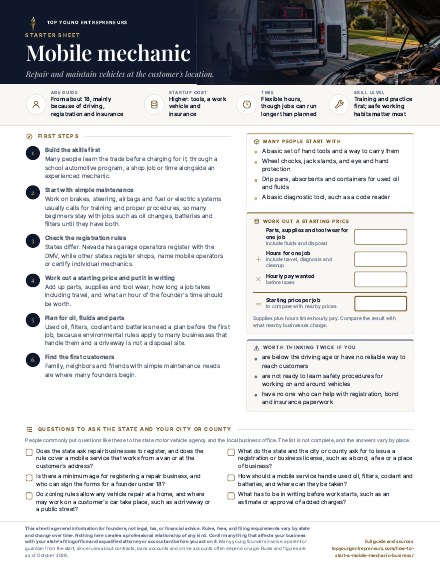
Free download
Mobile mechanic: the one-page starter sheet
The first steps, a starter kit, a simple price worksheet and the questions worth asking locally, on one easy-to-print page.
Keep reading
- LLC vs. sole proprietorship How the two structures compare, described without telling you which to pick.
- The LLC formation checklist A map of the typical stages if a business grows into a company.
- How to get an EIN What the IRS's free business number is, who applies for one and the steps, from the IRS's own pages.
- How to start a business in Nevada The LLC steps, state fees, forms and local licenses in one state, with a printable checklist.
- The best states to start a business in 2026 A sourced comparison of state taxes and filing fees.
- Founders we have profiled Real people who built companies young, independently verified.
- How Top Young Entrepreneurs works Our editorial standards and how we source facts.
This article is general information for founders, not legal, tax, or financial advice. Rules, fees, and filing requirements vary by state and change over time. Nothing here creates a professional relationship of any kind. Confirm anything that affects your business with your state's filing office and a qualified attorney or accountant before you act on it.
Many young founders involve a parent or guardian from the start, since rules about contracts, bank accounts and online accounts often depend on age.
- Nevada Revised Statutes, chapter 487: Repair, removal and disposal of vehicles: the definition of a garage, registration, bond and fee, estimates and penalties (revision dated April 2026)
- Nevada DMV: Garage registration information (form OBL 274, 08/2025): the DMV's checklist for registering a garage
- Nevada DMV: Vehicle industry and drive school licensing: includes an online tool for verifying garage registrations
- EPA: Section 609 technician training and certification programs: who must be certified to service car air conditioning, and the approved programs
- EPA: Regulatory requirements for MVAC system servicing: the rule against venting refrigerant
- 42 U.S.C. 7522: Prohibited acts (Clean Air Act): the federal rule on removing or disabling emission controls
- EPA: Managing used oil, answers to frequent questions for businesses: which businesses count as used oil generators
- Ohio EPA: Running a mobile oil changing business? Know your Ohio EPA regulations (2022): one state's explanation of used oil rules for mobile oil-change businesses
- Nevada Administrative Code, chapter 444 (NAC 444.8632): Nevada's rule on managing used oil by reference to federal standards
- Truckee Meadows storm water best management practices handbook (2007): northern Nevada guidance on mobile fueling and lubrication
- California Bureau of Automotive Repair: Mobile repair regulations (October 2025): an example of a state that has rules for mobile repair businesses
- Florida Statutes, section 559.903: Motor vehicle repair definitions (2025): an example of a state registration law that names mobile repair shops
- Michigan Motor Vehicle Service and Repair Act, Act 300 of 1974: an example of a state that certifies individual mechanics
- O*NET OnLine: Automotive service technicians and mechanics: U.S. Department of Labor description of the work and the usual preparation
- City of Las Vegas: Operational standards for a home occupation permit: an example of a city that limits vehicle repair at home
- Triple-I: Business vehicle insurance: personal auto policies and business use of a vehicle (an insurance-industry source)
- California Department of Insurance: Commercial insurance guide: common exclusions in general liability policies
- Texas Department of Insurance: Commercial general liability insurance: what general liability covers and the pollution exclusion
- Nevada Revised Statutes, chapter 483: Drivers' licenses: instruction permit age and the conditions on licenses for 16 and 17 year olds
- 29 CFR 570.34: Work 14 and 15 year olds may do: federal child labor rule for employees that limits car and truck work
- SBA: Apply for licenses and permits: why many small and mobile businesses still register locally
Last verified: October 1, 2026. Rules, fees and age limits change, so confirm current details with the source before acting on them. This article is educational, not legal, tax or financial advice.